Our World Word by Word
Sign up with your email address to receive news and updates.
Discovering Ourselves: Memories of Making a Blog Mask
How delighted I was when a notice from my friend and AROHO
alum Martha Andrews Donovan popped into my email inbox announcing a post for her
blog, MarthaAndrews Donovan: One Writer's Excavation. Reading this post, I felt a real burst of
pride. After all, I had been there when
the seeds for that blog were planted.
At the 2013 A Room ofHer Own Foundation’s summer writing retreat, Martha and I participated in Tania Pryputniewicz’s small group titled “Transformative Blogging”. The focus of the group was the creation of a
mask that could be a physical representation of what our blogging persona would
be or become. Along with making a mask,
we wrote about what we wanted from blogging, what our writing focus would be,
what the mask might reveal – or not reveal - about ourselves.
Thanks to Tania I had been blogging since the 2011
AROHO retreat and had already taken another blogging class she taught, so I didn’t
really expect any new insights about my writing. I just wanted to make a mask and have
fun. As the participants paired up, I found myself with
Martha. Although we had met in 2011, we
hadn’t really gotten to know each other.
Deciding to make masks together felt a bit risky.

We started with me. I
lay down on my yoga mat, and Martha began putting the plaster strips on my face. It was very cool and wet. We had read in the instructions that the
person putting on the plaster should talk to the “plasteree“ during the drying process, so before we started I asked Martha to tell me stories about her mother’s
life. Since my mouth was covered in
plaster, I couldn’t interrupt her or jump in with my own stories. All I could do was make murmuring noises to
show I was listening and feeling fine. It was wonderful
listening to Martha’s calm, soothing voice tell stories of her India-born mother
and missionary family. I could picture
that world of India and missionaries, of a New England family so unlike my own. She made me want to meet those women and ask them
about their experiences.
Then when my mask was done, Martha decided I should plaster
her foot instead of her face. It was
such an intimate experience making that foot mask. I’m not sure I had ever touched a relative
stranger’s foot before. I loved the feel of the plaster as I smoothed it with
my fingers, how delicate my movements had to be to keep from bunching up the
strips. It was almost meditative to dip
the strip in water, lay it and then smooth it until no seams showed. It was almost like caressing her foot. I felt I was giving her something, helping to
uncover a part of her in some way.
Dipping and smoothing, dipping and smoothing.
I didn’t want to stop.
 .
.
Afterwards, when I first saw my mask I was disappointed. It didn’t look like a face at all; rather it
was rough and mummy-like. Martha
apologized and asked if I wanted to change it, but I decided keep its original
form. Perhaps its roughness could tell
me something. And as I began to paint it, that coarse texture became something other than a face, it became part of the landscape around me. The blue New Mexico sky, the clouds that rose over the desert each day, Pedernal Mountain. I surprised myself with that painting – because I had painted a place, not a person. I realized it all made sense because it is places that that so often are important to my writing and to me. Finding my place, describing places I go, building the world one word at a time as I describe where I have been or where I am right now.


My mask is not a face, but a landscape. And Martha’s mask isn’t a face either, but a
foot. A foot to embody the journey
she is on, trying to find the way along her path. When it came for her to decorate this mask, she
covered her foot with the most amazing assortment of beads, feathers and scraps
of paper with inspirational quotes. It is ornate and intricate. And as I read her blog post about photographs
of people unknown to her, or small objects found buried, I realized that her
foot mask, rather odd and not quite the usual thing, was like one of
those enigmatic objects that so fascinate her.
This mask could represent her impetus to uncover mysteries left by others. Because by writing about those mysteries,
Martha tries to stand in the world of those unknown people for just a while.
And so those masks we made last summer really do reveal our
deepest motivations for writing, what our blogs would be, have turned out to
be. In her blog, Martha uses a Telugu
proverb she learned from her mother: “By digging and digging the truth is discovered.”
Isn’t
that what all writers are trying to do?
Digging down to find the truth about themselves and the world around them? Even though I didn’t believe it at the time,
making those masks was an important step in that digging process for Martha and me.
Postcards from Sea Ranch: Two Haiku
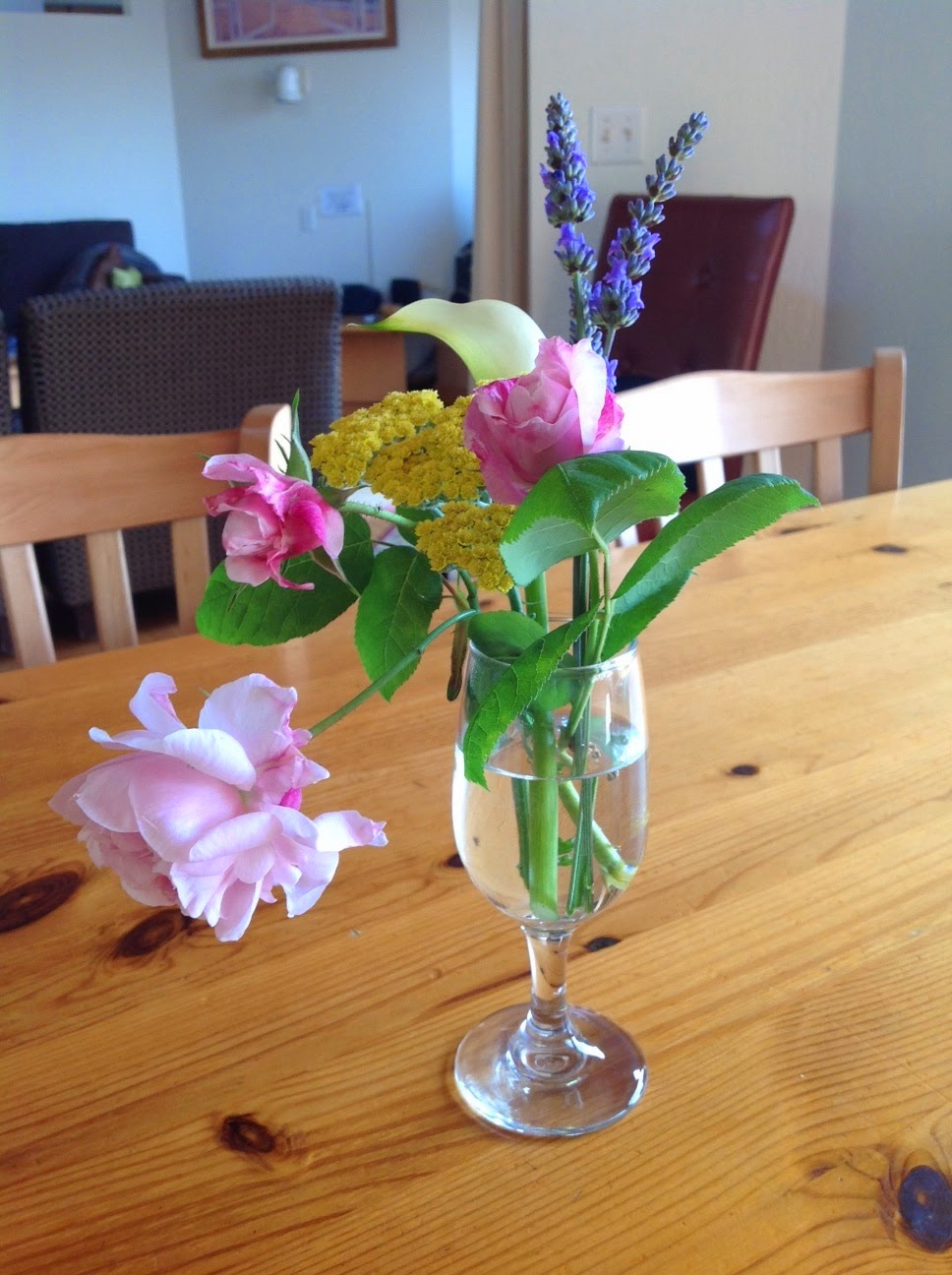
roses lavender
yarrow calla lilies poised
make this week’s house home

ocean mist rising
bluejays over sea grass call
cast for morning tide
Saying Goodbye to Room 31

In any case, when August comes, instead of standing at the door to Room 31 to greet a fresh bunch of middle schools students, I'll start my new job as a district English Coach working with teachers to help them with their own students.

Saying goodbye to this dusty old classroom with peeling window paint and rickety furniture older than my career is bittersweet. Being teacher has been so much a part of my identity for so many years that I'm nervous about who I will be and become. I'm like one of my eighth graders going off to high school.
And of course all this uncertainty has come out in writing. Here are some haikus about how it feels to end this part of my life:
twenty-three years one
classroom time to close the door
step into unknown
Steinbeck: teaching great
art melding mind and spirit
what will stir me now?
eight more days to teach
asked my friend what will I be
poet she replied
paper folders books
paper folders books all packed
now to say goodbye
Farewell to Poet Mother Maya
“Poetry put starch in my backbone.” — Maya Angelou
Years ago I was privileged to hear Maya Angelou speak before a large audience of teachers. This statement that she made about the importance of poetry has stayed with me. In fact I’ve had a poster with these words in my classroom ever since.
This morning I woke up thinking about this statement. Then I heard that Maya had died this very day. I like to think she visited me as she went on her journey. So like so many other writers around our country, I felt compelled to write about her. How she would love to read all the poems written in her name.
Mother Maya passed
in dreams today reminding
me stand up stand tall
Northern California Haiku
This weekend I got to spend some quiet time on the edge of the Pacific Ocean in Northern Sonoma County. No cell phone or wifi, just waves and whales, stars and moon - but of course I still wrote my daily haiku!

 5/9/14
waves crash below cliffs
hot tub bubbles as week's cares
offered up to moon
5/10/14
pelicans take flight
whales northbound on day's bright now
begin our own yes
5/11/14
Happy Mother's Day
nose up flippers down
mama seals and babies rock
sea wave nursery
5/9/14waves crash below cliffs
hot tub bubbles as week's cares
offered up to moon
5/10/14
pelicans take flight
whales northbound on day's bright now
begin our own yes
5/11/14
Happy Mother's Day
nose up flippers down
mama seals and babies rock
sea wave nursery
My Writing Process Blog Tour
I
was quite excited when my good friend Ruth Thompson
asked me to participate in the "My Writing Process" Blog Tour.
I met Ruth three years ago at my first AROHO
(A Room of Her Own) summer writing retreat at Ghost Ranch. Since that
time we have become fast friends, close enough to risk bunking together at the
2013 retreat.
Since
the beginning of this blog tour, I have had a wonderful time reading the wide
range of writers' answers to these four questions, especially those of Ruth
and other AROHO sisters, Esther
Cohen, Tania
Pryputniewicz and Marlene Samuels.
What a joy to read each person’s responses and learn more about her. It is an honor to join their ranks.
What
are you working on right now?

As
always, I'm just trying to lay words down on paper. At the moment I'm
working on poems for a memoir. I've been interested in writing a memoir for
years. It's always been one of my favorite genres but I had never thought
of tackling one until I took a class that focused on writing what I think of as
a hybrid memoir - one composed of poems as well as short vignettes and prose
poems. I've done some research on this and found the term "lyrical
memoir" so maybe that's what I can call it. It had never occurred to
me that so many of my poems could be thought of as memoir until starting this
project, but when I look at them it makes a lot of sense. I've just
started on this idea, so it feels very young and fragile, but I'm excited by
the prospect of nursing this baby along. It gives me an
"assignment" - which is something I enjoy. I guess it's the
teacher in me. Also, putting it down in black and white – coming out as it were - makes this work seem more
real. Having announced to the world that I'm doing this means I have to
keep going!
How
does my work differ from others of its genre?
What
a question! I like to just write what comes to me and see what
happens. I’ve never spent a lot of time reflecting on my work in that
way, I think because it would open up all my insecurities and let out that big,
bad self-critic. But if I must answer
this, then I would say most obviously my work differs from others because it is
mine, because it is written in my voice, from my perspective of the
world. No one else can view the world with my eyes.
My
writing has been called simple, clear and gritty. What I think this means
is that I use simple language to create poems people can understand. I
think the gritty means I'm not afraid to put down on paper even my most
unflattering thoughts and feelings. And I do think this makes my work
different. I don't want to hide behind elaborate metaphor or
imagery. I want people to understand what I write, to be able to connect
with it. I want to say plainly what I have to say using simple words in
the most poetic way I can. For years I agonized over how simple my language is,
but then someone sent me this poem by William Stafford:
THINKING
ABOUT BEING CALLED SIMPLE BY A CRITIC
I wanted the plums, but I waited.
The sun went down.
The fire
went out. With no lights on
I waited. From the night again—
those words: how stupid I was.
And I closed my eyes to listen.
The words all sank down, deep
and rich. I felt their truth
and began to live them. They were mine
to enjoy. Who but a friend
could give so sternly what the sky
feels for everyone but few learn to
cherish? In the dark with the truth
I began the sentence of my life
and found it so simple there was no way
back into qualifying my thoughts
with irony or anything like that.
I went to the fridge and opened it—
sure enough the light was on.
I reached in and got the plums.
went out. With no lights on
I waited. From the night again—
those words: how stupid I was.
And I closed my eyes to listen.
The words all sank down, deep
and rich. I felt their truth
and began to live them. They were mine
to enjoy. Who but a friend
could give so sternly what the sky
feels for everyone but few learn to
cherish? In the dark with the truth
I began the sentence of my life
and found it so simple there was no way
back into qualifying my thoughts
with irony or anything like that.
I went to the fridge and opened it—
sure enough the light was on.
I reached in and got the plums.
It's
become my mantra so whenever I feel insecure about my simplicity, I bring this
to mind.
Another
aspect that defines my work is a sense of place. I believe my nomadic
early childhood created a need for me to experience deeply whatever place I am,
to observe everything around me to keep the memory safe when it came time to
leave. So much of my work is about place, whether it about places of my
childhood or my travels. That's another thing, travel - I am a passionate
traveler and always find something to inspire my writing when I am shaken loose
from my everyday life to go experience somewhere new.
Why
do I write what I do?
Why
do any of us write what we do? Because we have to! I write the words that
come to me, sometimes in the night, sometimes as I am walking under wide trees
or sailing for the first time. Sometimes the words come on a bus in
Turkey or Thailand. They come when I am cooking with my mother or
watching my niece cut flowers. I write what I write because the world is
so beautiful and so terrible that I have to put into words what I see and hear,
taste and touch. I write because of the ache of love or sadness, the joy
of a bird's nest outside my door or grief over a friend's death. I write
because the words come demanding I put them to paper.
How
does my writing process work?
For
years I feared I had no writing process! I felt like I was just stumbling
along and every once and a while a poem would spring out of me rather like
Athena from Zeus' forehead! Of
course that wasn't really true, but I had so much trouble finding a way to meld
writing and my other working life together that I spent a great deal of time
struggling. Being a teacher means talking and giving and draining myself
each and every day. While this can be rewarding, it isn't very conducive
to coming home and gathering thoughts to put on paper.
So
last year I finally gave in and realized if I was ever going to get any
serious, sustained writing done, I would have to overcome my resistance to
getting up early. And since last August I've done that (257 days and
counting). Every morning I get up and perform a little ritual to get me
started. Then I sit down in my chair with a thermos of tea and
begin. I use this time to purge the happenings of the previous day,
writing longhand in my journal for as long as it takes for something
"writerly" to come up. I make lists of ideas to work on over
the weekend when I have more free time to concentrate. I dog-ear journal
pages that seem promising. Sometimes I start working on those ideas right
away; sometimes I let them stew for a while. At the end of each journal,
I go back through and record any of the ideas still unrealized into a small
notebook full of idea “seeds” (a term I got from Tania Pryputniewicz).
Sometimes those seeds sit unplanted for months or years.
I
am a big fan of writing to prompts and exercises. Somehow being given a
subject to write on shakes my mind free. I know many people find
exercises scary or boring or confining but I love them. Maybe that's also
why I love to travel so much. Every day on the road is like one big
writing exercise offering up ideas for my pen.

And now it's time to pass the baton to three more talented writers.
The
first person on my list is Lisa Lutwyche. I met Lisa at the AROHO retreat in 201l and then
again in 2013. She is not only a talented writer but also a wonderful
artist and teacher. I have one of her watercolors hanging over my writing
desk. It is of Chimney Rock in Ghost
Ranch, and offers me inspiration everyday.
Lisa
received her MFA in Creative Writing from Goddard College (in Vermont) in
2013. She is an Adjunct Professor of English at Cecil College in North
East, MD, and is also an instructor in the Fine and Performing Arts department
at Cecil. Poet, playwright, essayist and novelist (at work on two books),
her work has been widely published in the US and in the UK. Her
publications include Mad Poets Review, Image and Word, Poppy Fields, Piano
Press, Pitkin Review, Falklands War Poetry, Minerva
Rising, the cancer poetry project 2, and Fiction Vortex. She
was nominated for a Pushcart Prize in 2000. Lisa has taught
writing workshops at AROHO (A Room of Her Own Foundation, a bi-annual,
selective, women's writing retreat at Ghost Ranch in the mountains of New
Mexico) in 2011 and in 2013. She was the recipient of the 2013 AROHO
“Shakespeare’s Sister” Fellowship for a one-act play, and has had two short
plays produced in Philadelphia. Lisa’s one-act play, A State of Being,
will be produced in Philadelphia in July.
Lisa
has been teaching creative writing (and art) at community arts centers for over
twenty years. She has a BFA in Studio Art, a BA in Art History (from
Youngstown State University in Ohio); she attended University of the Arts and
Pennsylvania Academy of the Fine Arts, and she spent 28 years in architecture
and design.
A
professional artist, Lisa's work has appeared in magazines and galleries for
decades; her artwork will appear on the cover of Undoing Winter, a
chapbook (Finishing Line Press) by good friend Shannon Connor Winward. Lisa
blogs at logophiliaclisa.
Another AROHO sister is Pamela Helberg. Pam and I met for the first time last summer
at Ghost Ranch. Her incredible humor and
positive presence was so invigorating. I
wish I could write with as much verve as she does.
She received her MA in Creative Writing from Western
Washington University where she studied under award-winning novelist Laura
Kalpakian. She founded and operated Fremont Place Books in Seattle and taught
English composition for many years at Whatcom Community College. Mostly
recently she worked in IT before quitting to go back to school for her master's
degree in Mental Health Counseling. Her essay “Body Language” appears in Beyond
Belief: The Secret Lives of Women in Extreme Religions, Seal Press,
2013. The mother of two grown daughters, Pam is currently working on her
memoir about lesbian parenting in the 1990s and lives with her wife, Nancy, in
Bellingham, Washington. She blogs regularly at pamelahelberg.com, most recently as part of the A to Z Challenge.
And last but not least on my list is someone who I have never
met in person! Juliana Lightle is an "cyber-friend" who I met while taking a online blogging course taught by Tania Pryputniewicz through Story Circle Network. Even though we haven’t met face to face, I
have enjoyed reading Juliana’s wonderful blog.
I hope someday to have the opportunity to actually sit down to one of
the wonderful meals she is always describing!
Raised on a family farm in Northwestern Missouri, Juliana became
a singer, college administrator, corporate manager, racehorse breeder and
trainer, management consultant, educator and author. Her first poem was
published in a statewide anthology when she was in high school. She holds
a Ph.D. in counseling from The Ohio State University and an M.A. in high
education administration and B.A in English from the University of Rhode
Island. She currently writes, teaches, sings, and raises horses in the
Panhandle of Texas.
She is a member of the board of the Story Circle Network, a
group dedicated to women telling their stories.
Juliana blogs at writingontherim.
Day 30: Haiku Continues While Saying Goodbye to Poetry Month 2014

National Poetry Month has been more of an adventure than I had expected. I took up the challenge of posting a poem every day for 30 days to prove to myself that I have the writing discipline to follow through. After having proclaimed my intentions to my entire online community, I had many, many witnesses to watch my progress.
Of course already having pledged to write a haiku every day in 2014 helped. My haiku practice was already in place, but before April those poems had been posted only in a private Facebook group. For the month of April, I had to find the courage to send my little haiku out into the big, bad online world. And I admit at first I was very nervous. After all, it's difficult enough to write a poem every day, much less a good one. Sending out any poem, the good, the bad and the downright uninspired seemed like a huge risk.
But the response from readers has been more positive than I could have imagined. I've gained more followers on Twitter and have had some of my haiku re-tweeted to spread them even further. That amazed me. In a workshop I attended about creating an online presence as a poet, the director of Poet's House in New York advised tweeting lines of poetry. He was so right. There are actually people out there who are looking for poetry online. I just had to give them what they wanted.
I even have some readers who want me to continue posting my daily haiku for them. The encouragement and readership I've gained makes me feel the need to keep sharing - perhaps just less often. I have cringed when posting poems that I didn't think were worthy, so from now on I'll just share the highlights of my weekly practice. And keep the others to myself. But I promise that I will write a haiku every day for the rest of the year. I'm up to 119 with only 246 to go.
And so on this last day in April, the 30th day of haiku postings, I bid National Poetry Month 2014 adieu with one more springtime haiku:
 flocks of hoodies swoop
middle school hallways winging true for June's promise
Day 29 National Poetry Month

turn east to face dawn
birds sing tree-ward morning songs
pull sun from night's bed
Day 27 National Poetry Month

sails wind bowed gold-dipped bay splash
salt spray baptism

Day 25 National Poetry Month
dreams of late haiku
by dawn it had fled so sad
this overfilled brain
by dawn it had fled so sad
this overfilled brain
Day 24 National Poetry Month
washed in opal twilight we
surely become pearls
Day 23 National Poetry Month
Where is your story?
Where is your song? Chickadee
invites us to sing
Where is your song? Chickadee
invites us to sing
Day 22 National Poetry Month
today half moon hides
behind wind-driven clouds while
dawn trees toss young leaves
behind wind-driven clouds while
dawn trees toss young leaves
Day 21 National Poetry Month
slow road down to sea
above green-graced hills such blue
yellow fields must shout
Happy National Poetry Month: My interview in The California Journal of Women Writers and Haiku Number 20
Recently Marcia Meier, my friend and fellow AROHO alum interviewed me for TCJWW: The California Journal of Women Writers. This online journal was founded in 2012 with the mission of "fostering and enhancing the visibility of North American female authors, and narrowing the wide gender gap found in discussions in the literary world" by featuring reviews of women’s literature as well as interviews. I am incredibly honored to appear on this wonderful site.
Interview: Lisa Rizzo

Marcia Meier recently spoke with Lisa Rizzo to discuss her poetry,
motivations, and inspirations threaded throughout her work. Rizzo is a
poet, blogger and world traveler who lives in the San Francisco Bay
Area. A middle school teacher by profession, Lisa has published a
chapbook of her poetry and blogs frequently about her travel
adventures. Her blog, Poet Teacher Seeks World, is chock-full of her insightful and keen observations during her global jaunts, which also informed much of her chapbook, In the Poem an Ocean. Her poems are earthly, nostalgic, piercing and always surprising.
Meier: What inspired you to begin writing poetry?
Rizzo: I started writing poetry because I was desperate. Even though I had always wanted to write, I only dabbled with it until I was in college. Then I began to attempt writing fiction. I tried over and over to write stories that withered away to dust as I struggled with the characters and plot. I just couldn’t make them live. Then one day, sitting in the big chairs in the university library where I always sat, out of sheer frustration I abandoned prose and tried to write a poem. No, I wrote a poem. It came bursting out of me in one swift flow and that was it. I’m not sure why I had never tried poetry before. I guess I had never thought someone like me could write poems. All my traditional liberal arts education had made me feel that poets were people far out of my realm. But there it was, a poem.
Haiku Number 20
sun seeps through curtains
light motifs across wood floors
salute Spring-bright day
Day 19 National Poetry Month
listen to eyes ears
head's trajectory down up
nodding yes to life
head's trajectory down up
nodding yes to life
Day 18 National Poetry Month
sipping purple blossomed sage
dance blue day to night
Day 17 National Poetry Month
Sandburg you were wrong
fog does not cat-creep it swoops
down to smother day